Embracing Efficiency: The Benefits of Cluster-Based Licensing over Volume-Based Alternatives
Tags: Search GuardLicensing


CEO / Founder
In the evolving landscape of data security, the structure of software licensing can significantly impact both the accessibility and scalability of technology solutions. Search Guard offers a distinctive cluster-based licensing model that contrasts sharply with the more common volume-based (node-based) licensing models used by competitors, such as Elastic’s X-Pack.
This article explores why Search Guard’s cluster-based licensing model presents a preferable option for businesses aiming to secure their data infrastructure efficiently and cost-effectively.
Cost Efficiency
Predictability in Budgeting:
Cluster-based licensing, as adopted by Search Guard, means costs are associated with the number of clusters rather than the number of nodes within those clusters. This approach significantly simplifies budget forecasts and financial planning for IT departments. Organizations can scale their infrastructure horizontally by adding more nodes to a cluster without incurring additional licensing costs, providing clear financial predictability and easing the administrative burden of managing and tracking node counts.Reduced Complexity in Licensing:
Unlike node-based models, where licensing costs increase with every additional node, a cluster-based model allows for unlimited growth within each cluster. This not only makes it easier to expand but also eliminates the potential for cost surges associated with short-term scaling needs, such as during testing or sudden increases in data volume.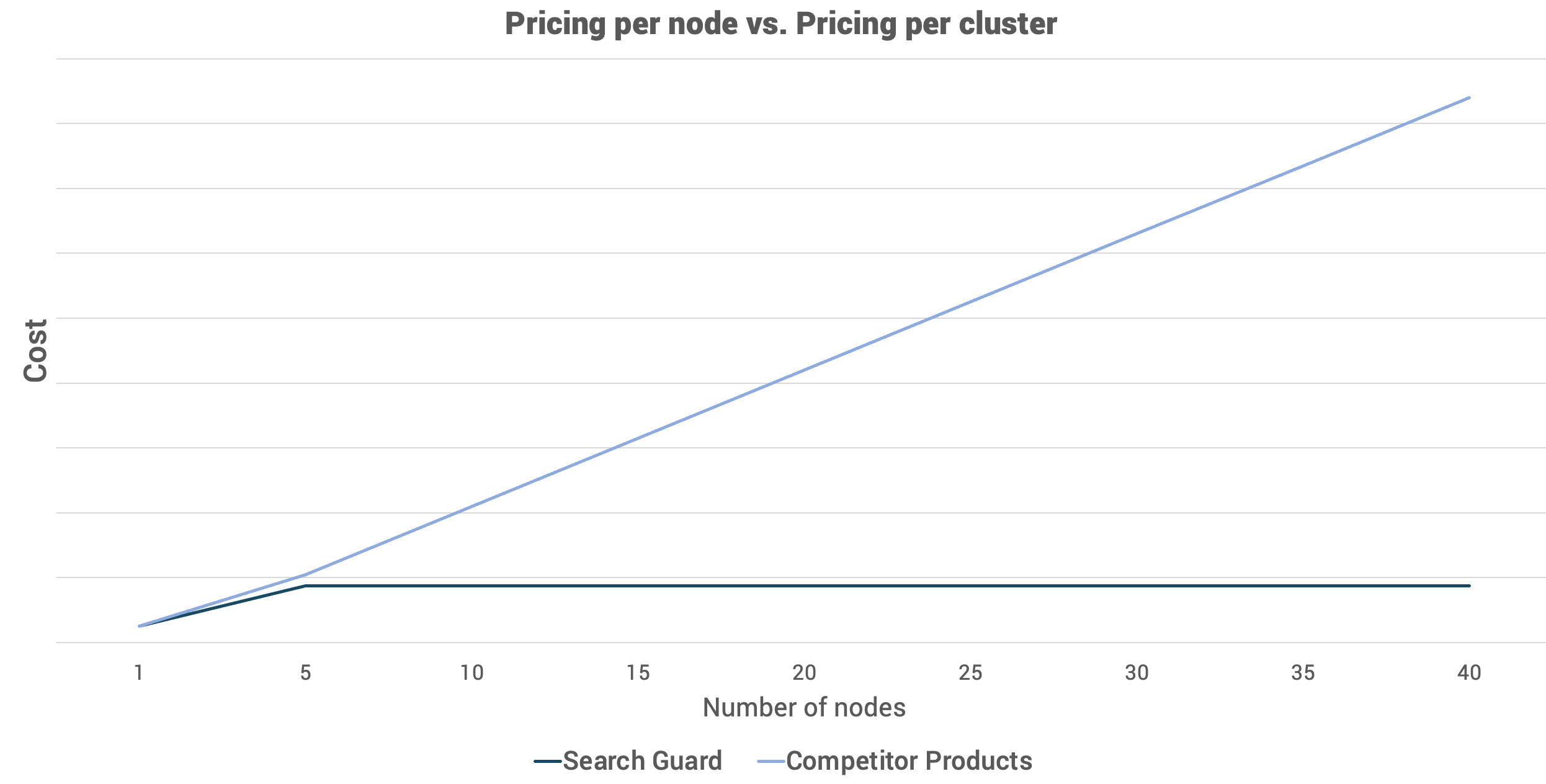
Enhanced Scalability and Flexibility
Encouraging Infrastructure Growth:
By decoupling licensing costs from the number of nodes, Search Guard incentivizes businesses to optimize and expand their infrastructure without the looming penalty of additional licensing fees. Companies can focus on what configuration best meets their needs — whether that means denser nodes with more powerful machines or spreading workloads across additional nodes to enhance resilience and performance.
Scale your cluster, not your cost
Adaptable to Varied Use Cases:
Cluster-based licensing accommodates a wide range of use cases, from small setups to enterprise-grade deployments. It is particularly advantageous for businesses with fluctuating workloads. Companies can adjust the composition of clusters in response to changing demands without revisiting the licensing terms, offering significant operational flexibility.Operational Efficiency
Streamlined Management:
Managing a single license per cluster rather than multiple node-based licenses reduces operational overhead. IT teams spend less time on administrative tasks associated with license management, allowing more focus on strategic activities that enhance business value.Avoidance of Over-Provisioning:
In node-based licensing models, there is a tendency to over-provision to buffer against potential scalability needs, leading to unnecessary costs. With cluster-based licensing, enterprises can add nodes as needed without financial penalties, ensuring a more efficient use of resources and reducing wastage.Fairer Cost Structure
Equitable Distribution of Costs:
Cluster-based pricing ensures that costs are more closely aligned with the value derived from the software, rather than the sheer scale of the infrastructure. This model benefits large and small enterprises alike, ensuring that smaller deployments with high node counts are not disadvantaged.Supports All Cluster Sizes:
Whether a cluster has three nodes or thirty, the licensing cost remains the same under a cluster-based model, making this approach particularly attractive for larger clusters. This scalability support is crucial for organizations looking to leverage high availability and fault tolerance features of Elasticsearch without worrying about exponential cost hikes.Conclusion
Search Guard’s cluster-based licensing model offers a compelling alternative to traditional volume-based licensing models. By prioritizing scalability, cost predictability, and operational efficiency, Search Guard provides a robust security solution that aligns better with business needs and growth trajectories than many of its competitors. This model not only supports technical and operational scalability but also ensures that companies can invest in their future growth with confidence, knowing that their security practices can scale efficiently and economically.
Search Guard has already helped companies to save millions in licensing cost. Get in touch with us to find out how we can help you saving money as well.
Search Guard - Scale your cluster, not your cost!
-------
Original Image Source: Stokkete on Shutterstock
Published: 2026-02-18
Summarize this with AI
Questions? Drop us a line!
Other posts you may like

The True Cost of an Elasticsearch Security Incident: 5 Mistakes That Can Turn Into a Breach
Daniel Gleim || 2026-10-13
In this article, we look at five common Elasticsearch security mistakes and the real costs organizations face when security gaps are left unaddressed.
read more

Fast-Tracking Compliance in Elasticsearch Using Search Guard
Daniel Gleim || 2026-06-11
Search Guard provides security and compliance features directly inside the Elastic stack-configurable, integrated, and designed for regulated environments.
read more

Cybernation Berlin 2026
Anja Glauch || 2026-06-01
Search Guard macht Elasticsearch-Cluster prüfungssicher: vom Login bis zur Verschlüsselung. Treffen Sie uns auf der Cybernation 2026 in Berlin.
read more
